
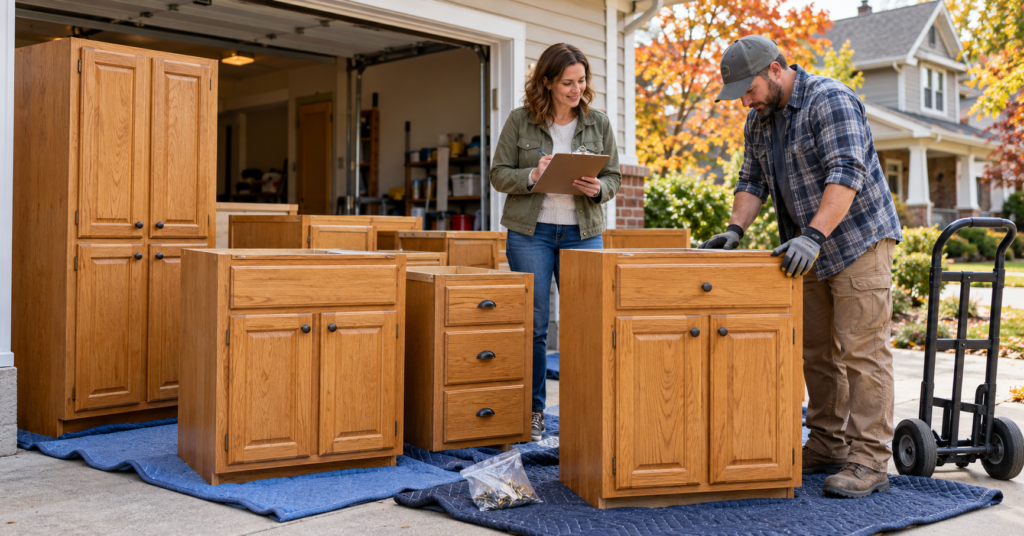
Cleveland cabinet donations can give usable kitchen cabinets another purpose, but getting them from your kitchen to a donation location may involve expenses that are missing from the remodeling estimate. Careful removal, utility disconnections, carrying, transportation, and temporary storage can all affect the final cost.
The financial question is whether those expenses are covered by your existing renovation agreement or require additional work. Before scheduling demolition, establish which cabinets a recipient will consider, who will prepare them, and how they will leave the property.
Confirm Acceptance Before Paying for Removal
The Cuyahoga County Solid Waste District’s guidance on usable building materials identifies cabinets as potential donations and lists Greater Cleveland Habitat for Humanity ReStore as a local option. Donated materials must be in good, usable condition.
That provides a starting point, but it does not establish that a particular kitchen will be accepted.
Send photographs showing the cabinet fronts, interiors, sink base, doors, drawers, and any visible damage. Include approximate dimensions and explain whether you are donating a complete set or selected units.
Ask whether the recipient needs the cabinet boxes to remain assembled and how hardware should be supplied. Also clarify whether approval from photographs is provisional and whether the collection crew makes the final acceptance decision.
Avoid paying for repairs or refinishing solely to make a donation possible unless the recipient has confirmed that the proposed work would address its concerns.
Separate Cabinet Removal From Donation Pickup
A collection appointment does not automatically establish responsibility for removing installed cabinetry.
Your written arrangements should identify who detaches the cabinets, disconnects affected utilities, carries the units out of the kitchen, and loads them for transport. Different people may handle each stage.
Ask the recipient where the cabinets must be waiting when the vehicle arrives. A garage collection and removal from a second-floor kitchen involve different work, even when both are described informally as “pickup.”
If your remodeling contractor already includes kitchen demolition, request the additional price for preserving cabinets intact. Check whether that figure replaces part of the original demolition allowance or is added to it. This helps prevent paying twice for the same removal work.
How to Budget for Cleveland Cabinet Donations
Request a written breakdown based on your actual kitchen and access route.
| Potential expense | What the quote should clarify |
|---|---|
| Careful removal | Whether cabinets will be detached intact and which units are included |
| Countertop separation | Whether removing the countertop is included and whether it must also be preserved |
| Utility work | Responsibility for affected plumbing, appliances, and electrical connections |
| Carrying and loading | Stairs, narrow doorways, long carrying distances, and loading assistance |
| Preparation | Cleaning, labeling, securing loose parts, and protective materials |
| Transportation | Collection fees, vehicle rental, mileage, delivery, or additional trips |
| Temporary storage | Where cabinets will wait and whether they must be moved again |
| Remaining waste | Disposal of rejected cabinets and materials that cannot be donated |
These are possible charges to clarify, not expenses every donation will incur.
Add the agreed amount to your broader kitchen remodel cost budget. Keep donation preparation visible as a separate line so you can track it without confusing it with new cabinet installation.
Check What Is Attached to the Cabinets
Ask the contractor to assess the installed kitchen before promising that every cabinet can be recovered.
Countertops, sinks, backsplashes, trim, and neighboring cabinets may affect the removal sequence. A cabinet that looks sound from the front can also have damage or connections that become apparent only when the surrounding materials are removed.
Have the contractor explain what will happen if preserving one unit would require substantially more work than expected. Agree on a point at which the crew pauses for your decision rather than continuing on an open-ended hourly basis.
Clarify surrounding repairs as well. If wall patching or floor repairs are already part of the remodel, they should remain distinguishable from any extra work caused specifically by the donation plan.
Plan the Carrying Route and Waiting Area
Before removal day, walk the route from the kitchen to the loading point with the contractor.
Check doorway widths, stair turns, handrails, parking access, and the space available for handling large units. If you live in a condominium or another building with shared access, confirm any elevator reservations or loading restrictions before booking collection.
Choose a dry, secure waiting area that does not block the renovation crew’s access. Cabinets stored where new materials must be delivered may need to be moved a second time.
Keep the collection date coordinated with removal and the arrival of replacement cabinets. Ask who pays for extra handling or storage if pickup is postponed. A clear arrangement is more useful than assuming the donation vehicle will arrive immediately after demolition.
Budget for Cabinets That Cannot Be Donated
A donation plan still needs a disposal backup.
The City of Cleveland’s waste collection guidance states that its Division of Waste does not collect construction and renovation debris through regular trash or recycling collection. The city directs residents to arrange an appropriate disposal option, such as a private hauler or city dumpster service.
Do not assume rejected renovation cabinets can simply be left for ordinary bulk collection.
Ask your contractor to price the removal of any units the recipient declines. Also establish who handles countertops, damaged cabinet sections, and other materials outside the accepted donation.
These are City of Cleveland rules. Homeowners in surrounding municipalities should check their own local collection requirements.
Compare the Actual Change in Your Remodeling Bill
Donating cabinets only reduces disposal spending when it changes what you would otherwise pay.
For example, removing cabinets from the waste stream may not reduce a fixed dumpster rental charge if the dumpster is still needed for flooring, drywall, and other renovation debris. Ask the contractor what credit, if any, will appear on the bill.
Consider this illustrative calculation, which is not a Cleveland market estimate:
- Additional careful-removal labor: $400
- Additional transportation: $100
- Confirmed disposal credit: $150
- Additional project cost: $350
The donation would cost $350 more under those assumptions, before considering any tax consequences. You might still choose it to keep usable cabinets in circulation, but the construction budget should reflect the actual expense.
Compare two written totals: ordinary removal and disposal, and removal with donation preparation. Include remaining waste in both.
Treat Tax Paperwork as a Separate Decision
A donation receipt is not reimbursement for your remodeling costs. Any tax benefit depends on your eligibility, the property donated, its supported value, and the applicable documentation requirements.
The IRS guidance on valuing donated property explains that used household items generally have a fair market value below their original purchase price. Do not use the price of your replacement kitchen as the value of the cabinets being donated.
For larger claimed deductions, appraisal and reporting requirements can introduce another expense. Generally, a deduction exceeding $5,000 for an item or group of similar donated items requires a qualified appraisal and Form 8283, subject to exceptions. The IRS also states that appraisal fees cannot be claimed as a charitable contribution.
If a potential deduction materially affects your decision, discuss the requirements with a tax professional before removal. Keep any expected benefit separate from the cash available to pay the contractor.
Document the Final Handoff
Photograph the cabinets after removal and keep an inventory of the units and components actually accepted. Retain the recipient’s acknowledgment, transportation invoices, contractor charges, and any agreed disposal credit.
If only part of the kitchen is accepted, make sure your records reflect that outcome. Close out the remaining waste arrangement promptly so the next stage of the remodel can proceed.
Note: Donation acceptance, collection arrangements, contractor prices, and municipal disposal rules can change. Confirm current requirements before scheduling removal, and obtain individual tax advice before relying on a deduction.