New York parapet repairs should begin with a clear explanation of what has failed. Worn mortar, a loose coping stone, and a wall that has started leaning may appear close together, but each calls for a different repair decision.
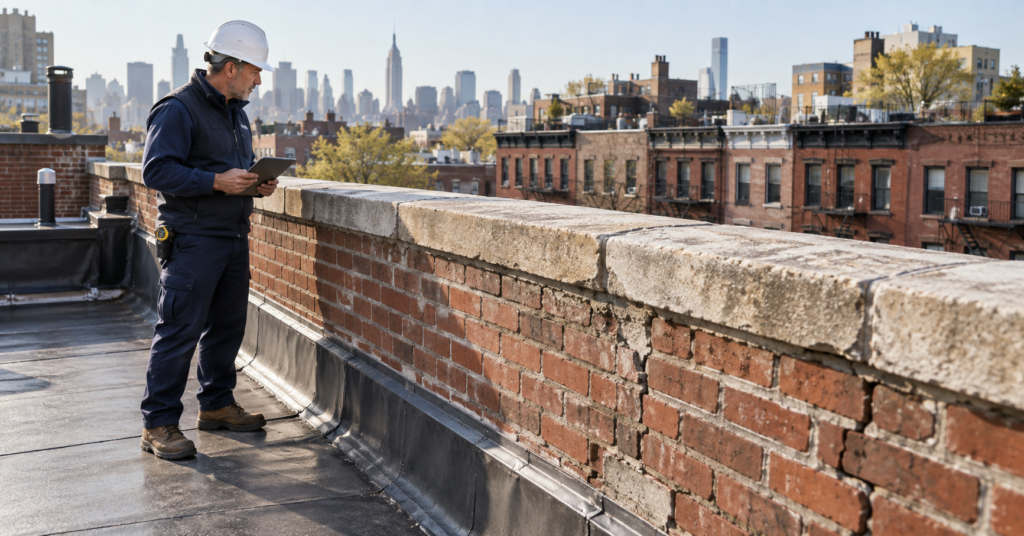
A parapet is the portion of a wall extending above the roofline. For owners of New York City buildings, maintaining it involves both the masonry itself and the connections that keep water out at the roof edge. Before accepting a proposal to patch, coat, or rebuild it, establish the wall’s condition, the proposed repair boundaries, and who will handle the adjoining roofing.
Check Whether NYC’s Annual Observation Requirement Applies
Since January 1, 2024, NYC has required annual observations of parapets facing a public right-of-way, regardless of building height, subject to specific exceptions. Detached one- and two-family homes are exempt. An attached townhouse does not qualify for that exception simply because it contains one or two homes.
A fence also does not automatically exempt a property. DOB’s guidance considers the position of a continuous barrier relative to the exterior wall’s height. Have the observer confirm how the rule applies to the actual building layout. The city’s parapet guidance and frequently asked questions explain the requirements.
For covered buildings, the observation and report must be completed by December 31 each year. The observer must be competent to identify parapet hazards; the annual requirement does not automatically mean every owner must hire an engineer. Structural concerns discovered during that observation may, however, require further professional evaluation.
Address Unsafe Conditions Before Scheduling Routine Repairs
Loose masonry, displaced coping, or apparent movement should receive prompt professional attention. Do not climb onto an exposed roof edge or push against the wall to test its stability.
When an observation identifies an unsafe condition, NYC requires immediate notification to DOB and immediate public protection as necessary. The unsafe condition must be corrected within 90 days of notification, with protection maintained until the hazard is remedied. That deadline does not allow an owner to leave a dangerous condition unprotected while collecting bids. These duties are set out in 1 RCNY §103-15.
Ask the professional handling the condition to explain the immediate protective measures, the permanent repair, and the sequence for completing both.
Decide Whether the Masonry Needs Repointing or Rebuilding
Repointing replaces deteriorated mortar within masonry joints. It can be appropriate where the surrounding masonry remains sound, but it does not resolve every cause of cracking.
The National Park Service’s guidance on brick masonry problems explains that cracks can result from movement, corrosion, support problems, and other conditions. Structural repairs should precede cosmetic work. A proposal that simply fills visible cracks needs further explanation if the wall is also bulging, leaning, or separating.
Ask the contractor to identify which areas can remain, which individual units need replacement, and whether any section requires dismantling and reconstruction. If the recommendation changes after opening the wall, request photographs and an explanation before approving additional work, unless immediate action is necessary for safety.
Where stability or anchorage is uncertain, seek an assessment from a New York licensed architect or professional engineer with relevant masonry experience. Our guide to when a home remodel needs a structural engineer explains the broader role of structural review.
Specify Mortar That Suits the Existing Brick
A repair specification should explain material compatibility as well as appearance.
Historic masonry can be damaged by replacement mortar that is excessively strong or restricts moisture movement. The National Park Service’s repointing guidance recommends evaluating the existing masonry and mortar before selecting a replacement. Matching color alone is insufficient.
For an older parapet, ask how the mortar was selected, how deteriorated joints will be prepared, and whether a sample area will be reviewed before work proceeds. Have the proposal identify the intended joint finish and how adjacent brick faces will be protected.
Also clarify whether existing coatings will remain. Nonpermeable coatings can trap moisture in historic brickwork and accelerate deterioration, so coating a damaged wall should follow an assessment of the moisture problem.
Coordinate Coping and Roof Flashing Repairs
Coping covers the top of the parapet, while flashing manages water at roof edges and transitions. Both deserve attention when masonry repairs disturb the roofline.
The Insurance Institute for Business & Home Safety’s metal flashing guidance addresses coping slope, joints, attachment, and the need to accommodate thermal movement. It also explains how counterflashing protects the upper edge of base flashing at a wall connection.
Ask for the proposed roof-to-wall detail before construction starts. Establish who will remove affected flashing, protect exposed areas, and reconnect the roofing after masonry work. If separate masonry and roofing contractors are involved, assign responsibility for that connection in writing.
For a coping replacement, the proposal should identify which pieces will be retained or replaced and how the new assembly will be secured. Confirm how any existing roof warranty will be handled before another trade alters the roof edge.
Confirm Permit Requirements for the Actual Scope
NYC does not treat every parapet repair the same way. DOB lists certain repointing, coping, and limited masonry work among permit exemptions, subject to the applicable conditions. Work exceeding those allowances requires the appropriate professional filing and permit process.
Review the city’s façade project requirements against the specific proposal. Ask the contractor or design professional to identify the basis for any claimed exemption. A description such as “minor roof repair” does not establish whether a parapet reconstruction qualifies.
Landmark status creates an additional review. For an individual landmark or a building within a designated historic district, check with the Landmarks Preservation Commission before changing masonry, mortar, or architectural features. Its restoration guide explains repair criteria and application materials. A DOB permit exemption does not, by itself, settle LPC requirements.
Compare New York Parapet Repairs Using Measurable Scope
Ask each bidder to price the same identified work. “Repair parapet” leaves too much uncertainty about quantities, access, and responsibility.
A useful proposal should state:
- The locations and measured areas of repointing or masonry replacement.
- The coping and flashing work included.
- The access equipment and public protection included, with rental periods where relevant.
- Who handles drawings, applications, required inspections, and completion documentation.
- How concealed damage and additional work will be priced and authorized.
Where quantities remain uncertain, ask whether the contractor can provide unit prices alongside the initial allowance. That gives you a clearer basis for reviewing changes after damaged material is removed.
Discuss the work schedule as well. Ask how the crew will protect unfinished areas from rain and meet the selected materials’ installation and curing requirements. Establish who maintains temporary protection if weather interrupts the project.
Keep a Repair Record After the Work Is Finished
Before closing out the contract, request completion photographs, final invoices, material information, applicable approvals, and any warranties. For reconstructed sections, photographs taken before concealed work is covered can help document what was installed.
Ask the responsible professional to explain any remaining maintenance items and confirm the status of required filings or inspections. A finished appearance alone does not establish that every contractual or administrative item is complete.
For the annual observation program, owners must retain reports for at least six years and provide them to DOB on request; routine report submission is not required. Keep those reports with the repair records so the next observer can understand what changed.
Note: This article addresses New York City requirements and provides general project-planning information. Conditions and approval requirements vary by building. Confirm the current repair scope and applicable rules with DOB, LPC where relevant, and a qualified professional before work begins.